
House Build Guaranteed Completion Date
Building a home is one of the biggest financial commitments most people will ever make – and having certainty around when your house will be ready to live in is often just as important as understanding the total cost.
A guaranteed completion date is a contractual commitment that sets a specific deadline for a home’s completion, subject to agreed conditions. If you are comparing builders, understanding the difference between an estimated house completion date and a guaranteed house completion date can make a real difference to how you plan your finances, your move and your peace of mind.
Delays can mean paying rent and a mortgage at the same time, loan drawdowns being pushed back, moving plans changing and extra stress for the whole household. This guide explains what a guaranteed completion date means, what “completion” actually looks like in practice and why your chosen build method matters.
What does “completion” mean for your build?

Your house completion date depends on how “complete” is defined in your contract. At Advance Build, the guaranteed completion date is tied to practical completion. This is the stage where the home is finished to the agreed standard, ready to be occupied and able to be handed over to the owner.
This is different from the Code Compliance Certificate (CCC). The CCC is a separate council sign-off process that happens after the build work is completed.
At handover, the owner receives the keys along with important documents such as warranties, maintenance information and relevant certificates. Contractors must provide copies of guarantees or warranties, insurance details where relevant, and information about maintenance once building work is completed – the government’s New Zealand Building Performance website is a great place to understand more about this process and your rights.
Key house build milestones
- Practical completion: the home is finished to the agreed standard and ready for occupation.
- Handover: keys, documentation and warranties are provided.
- Code Compliance Certificate (CCC): council confirms the consented work complies with the building consent.
What is a guaranteed completion date?
A guaranteed completion date is a contractually committed completion date, rather than a target or estimate. In simple terms, an estimated date is what the builder expects to achieve, while a guaranteed date is the date the contract commits to, subject to agreed conditions and exclusions.
That distinction matters because not all completion dates offer the same level of certainty. Some builders offer guarantees because they have stronger control over their process, scheduling and delivery model. Others work with estimated dates because more parts of the build remain outside their direct control.
Before signing, ask what the guarantee actually covers, what milestone it is tied to and what conditions may affect it. Not all guarantees are structured in the same way, so it is important to understand exactly what your contract does and does not cover.
| Estimated completion date | Guaranteed completion date |
| A target based on expected timing | A contractual commitment subject to agreed conditions |
| May shift if delays occur | Must be read alongside exclusions, extensions and contract wording |
| Often used where there is less scheduling control | Often offered where the builder has more confidence in process control |
| Helpful for planning, but less certain | Designed to give a firmer basis for planning your move and finances |
What causes delays in traditional house builds?
Common causes of house building delays include:
- Weather disruptions: rain, wind and poor ground conditions can stop work during foundations, framing and exterior stages
- Labour shortages: if a required trade is not available at the right time, progress can stall between stages
- Material delays: back-ordered products or supply-chain issues can hold up specific parts of the build
- Scheduling issues: poor sequencing can create gaps where no work is happening on site
- Multiple subcontractors: more handover points can mean more opportunities for delays to compound
- Site access problems: difficult or remote sites can make it harder to coordinate trades, deliveries and machinery
For many buyers, these risks and potential delays feel more serious in today’s market. News of firms folding mid-project has made certainty, transparency and strong processes feel more important than ever.
How Advance Build reduces timeline risk
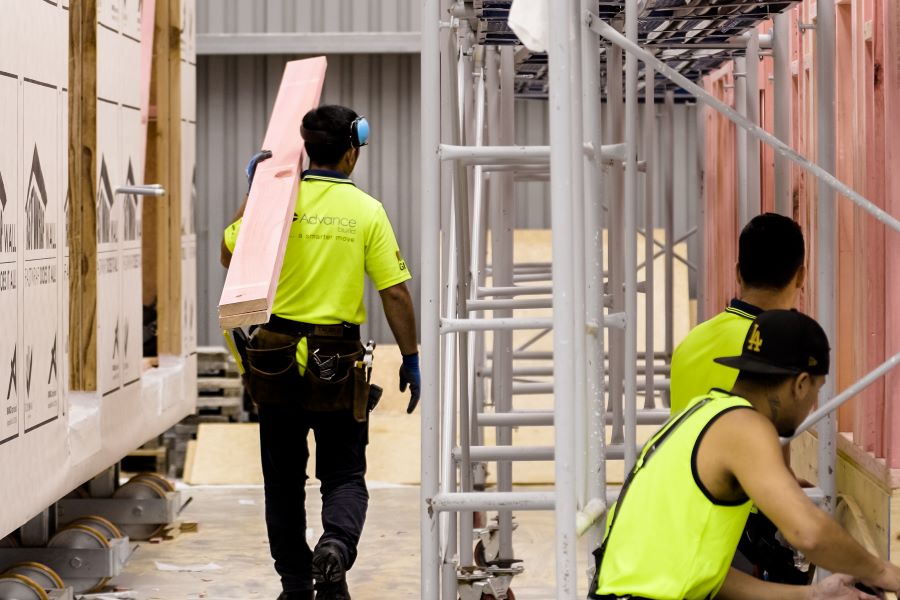
Advance Build’s model is built around factory-based construction and end-to-end project management. That does not remove every possible risk, but it does reduce many of the common causes of delay found in traditional on-site builds.
One of the key advantages of factory-built construction is that parts of the project can move forward in parallel, rather than waiting for every stage to happen one after the other on site. Site readiness can progress alongside factory construction, helping reduce downtime and create a more streamlined overall timeline.
Here is how the process works.
- Free floor plan and quote
You choose an Advance Build plan, your own design, or a combination of the two. Advance Build then provides a full turn-key proposal so you can understand the likely cost up front. - The Home Starter Pack
A deposit secures concept plans and detailed pricing, reserves your place in the build schedule, and helps identify any site-specific challenges early. - The contract
This is the stage where the completion date is locked in. The signed contract sets out payment terms, specifications and the agreed completion date. - Factory construction
Once consent is issued, the home is built under cover in Advance Build’s controlled factory environment. This stage typically takes around eight to nine weeks. Factory construction helps reduce weather-related disruption and supports tighter scheduling control. - Delivery to site
The finished home is transported to site, placed on its foundations and remaining site works such as connections, decks or garages are completed. - Handover and move in
At practical completion, you receive the keys and take possession of the finished home. This is the point Advance Build commits to as the guaranteed completion date. CCC will be obtained from your local council as part of the wider process, but it is separate from the practical completion milestone.
Questions to ask before signing your building contract
Is the completion date guaranteed, or only estimated?
Clarify which type of date the contract commits to, as this determines how much certainty you can rely on when planning your move, finances and notice periods.
What factors could extend the timeline, and how will these be managed?
Ask the builder to explain which events allow the date to shift, how often these occur in practice, and how adjusted timelines will be managed and communicated.
Other things to check before signing your building contract:
- How “completion” is defined in the contract
- Any exclusions or limitations that apply to the completion date
- Any delays that are considered ‘outside the builder’s control’ are clearly explained
- How updates and delays will be communicated – make sure the communication process is clearly set out.
House build timeline checklist
Use this checklist to track the key stages of your project:
☑ Budget approved: finance and budget are confirmed before design commitments begin.
☑ Contract signed: the build contract includes the completion date and key terms.
☑ Construction underway: factory build and any parallel site works are in progress.
☑ Site works complete: earthworks, foundations and services are ready for installation.
☑ Handover scheduled: final inspections are booked and a handover date is confirmed.
Certainty builds confidence
A clear building completion date matters because it affects far more than the build itself. It shapes your budget, your mortgage planning, your moving date and your overall confidence in the process. That is why it is important to understand whether your contract gives you an estimated date or a guaranteed one, and how that date is defined.
Factory-built homes can improve predictability because more of the build happens in a controlled environment, with fewer weather delays, better coordination and stronger oversight. When you combine that with an experienced builder managing the process from design through to handover, you have a clearer path to a more certain outcome.
Planning a new home build?
Talk to Advance Build about factory-built homes designed to provide greater cost certainty, streamlined construction timelines and a clearer path to completion.
FAQs
Frequently asked questions about house build completion dates
What is a guaranteed completion date?
A guaranteed completion date is a contractual commitment that sets a specific deadline for a home’s completion, subject to agreed conditions. It gives the buyer a firmer level of certainty than an estimated completion date.
How long does it take to build a house in NZ?
A house build timeline in New Zealand can vary depending on the design, consent process, site conditions and build method. Traditional on-site builds often face more variables, while factory-built homes can offer a more controlled timeline because more of the work happens indoors and under one coordinated process.
What causes house build delays?
Common causes of house building delays include weather disruptions, labour shortages, material delays, scheduling gaps, subcontractor coordination issues and site access problems. The more variables involved in a project, the more likely it is that timelines will shift.
Are factory-built homes faster to complete?
Factory-built homes can often be completed more predictably because construction takes place in a controlled environment with fewer weather disruptions and fewer gaps between stages. Timing still depends on factors such as consent, site works and contract conditions, but the process can reduce several common causes of delay.